When I first started my laser-cut keychain business three years ago, the biggest question I got from customers wasn’t about material choices or design complexity—it was, “Can you make a keychain that changes color when it’s warm?” At the time, I had only dabbled in basic acrylic engravings and wood cuts, so thermal-sensitive elements felt like a wild, untested add-on. Over the past two years, though, I’ve built a line of custom laser-cut keychains that integrate temperature-reactive materials, and today I’m walking you through exactly how it works, what to expect, and whether this is the right upgrade for your next project. Laser-cut Keychains
First, let’s get the science out of the way without making your eyes glaze over. Thermal-sensitive materials used in keychains rely on a type of chemical compound called leuco dyes, or thermochromic pigments. These are microcapsules of colored dye mixed with a color developer and a solvent that melts at a specific temperature. When the temperature drops below that solvent’s melting point, the solvent is solid—so the dye and developer are pressed together, creating a visible color. When it warms up above that threshold, the solvent liquefies, the dye and developer separate, and the color disappears. That’s why you’ll see thermochromic mugs: touch the surface with a warm hand, and the design fades or shifts.
There are two main types of thermochromic materials we use for laser-cut keychains, and they’re not interchangeable. The first is thermochromic acrylic, which is solid plastic with the pigments embedded evenly throughout. The second is thermochromic vinyl, a thin, flexible film that you can cut and apply to a base keychain material (like clear acrylic or wood). Both have pros and cons, depending on your design needs.
Let’s start with thermochromic acrylic because it’s the most straightforward for laser cutting. Most standard acrylic has a matte or glossy finish, but thermochromic acrylic is a specialty stock we source from a few industrial plastic suppliers. It comes in a range of transition temperatures, which is key. If you want a keychain that changes when you pick it up from your pocket (body temperature is around 98.6°F, or 37°C), you’d pick a thermochromic acrylic with a transition temperature of 32°C—just below body heat. If you want a keychain that reacts to warm drinks or hot car interiors, you’d go higher, like 45°C or 55°C. The pigment concentration is also consistent, so the color shift is uniform across the entire part, no splotchiness, as long as your laser settings are right.
Now, here’s where laser cutting gets tricky, because thermochromic acrylic is more heat-sensitive than regular acrylic. Regular acrylic melts cleanly at around 350°F, but thermochromic pigments break down at temperatures above 200°F. If you crank your laser power too high, the cut edge will turn yellow, the pigment will fade, and your keychain won’t transition correctly. After months of trial and error, we landed on a sweet spot for 1/8-inch thick thermochromic acrylic: 15% power, 50 mm/s speed, and 100 PPI (pulses per inch) for a clean cut that preserves the pigment. We also add a small offset to our cut paths, so the edge of the design doesn’t sit too close to where the laser beam passes. For example, if we’re cutting a 2-inch circular keychain, we don’t trace the exact perimeter—we cut 0.005 inches inward from the outline. That might sound like a trivial adjustment, but it prevents the laser from burning the edge where the thermochromic layer is thinnest.
The other option, thermochromic vinyl, is better for more intricate designs or for pairing with non-thermochromic base materials. Vinyl is thin (usually 1 to 2 millimeters) and comes in a wide range of colors and transition temperatures, from cold shifts (activating above a specific temp) to hot shifts (activating below a specific temp). For our wood keychains, we often cut a custom shape from thermochromic vinyl, weed out the excess, and adhere it to a laser-cut wood base. This works because the vinyl is applied as a top layer, so the wood is only used as a sturdy backing. The downside? Vinyl is less durable than acrylic. If you twist your keychain repeatedly or leave it in a hot car for weeks, the adhesive can peel, and the vinyl can scratch. We fix this by using a permanent, heat-resistant acrylic adhesive when applying the vinyl, and we test each batch of vinyl for fade resistance before we use it for bulk orders.
Over the past year, we’ve made thermal-sensitive keychains for a range of clients—from small businesses doing promotional merch to indie creators selling custom hobbyist designs. One of our most popular orders was for a coffee shop that wanted keychains shaped like their logo, where the logo changed from plain brown (matching the shop’s brand) to bright red when you hold it. We used thermochromic vinyl on a white acrylic base, and the transition temperature was set to 35°C, so it would shift after a customer held it for a few seconds. The shop told us it became a top-seller, with customers coming back to buy multiple for friends.
But it’s not all smooth sailing. There are a few big limitations to thermal-sensitive keychains that you need to know before you place an order. First, the color shift is reversible, but the more you go through the cycle (warm to cold to warm), the faster the pigment breaks down. Most thermochromic materials have a lifespan of 1,000 to 10,000 cycles, which is fine for a keychain that you use daily, but if you’re making a keychain that gets exposed to extreme heat (like a keychain left on a dashboard in Arizona in summer), you can expect the color to fade after a few months. Second, you can’t use white thermochromic materials for dark bases. If you put a clear thermochromic vinyl on a black acrylic base, you won’t see the color shift at all. We always test the color contrast for each design before production—for example, a red thermochromic vinyl only works on a light base, and a dark blue works on a white or gray base. Third, laser marking thermochromic materials is different from laser cutting. If you want an engraved detail that also changes color, you have to adjust your settings even more—we use 10% power and 200 mm/s speed for engraving, so we don’t remove too much of the thermochromic layer.
Another thing we’ve learned is that customer expectations matter a lot. Some people expect the color shift to be dramatic—like going from black to neon pink in a fraction of a second—while others want a subtle shift, like going from light blue to navy. We always send a test sample before any bulk order, so you can see exactly how the color looks, how fast it transitions, and how it holds up to wear. Last quarter, a customer ordered 500 keychains for a hiking brand, and they initially thought their design’s color shift was too faint. We sent a test sample and showed them how the shift would look when held in a hand, and they adjusted their design to use a more saturated pigment, which fixed the issue.
If you’re thinking of adding thermal-sensitive keychains to your product line, there are a few design tips to keep in mind. First, keep large solid areas of thermochromic material. If you have a tiny, intricate detail, the thermochromic pigment might be too concentrated or diluted, so the shift will be uneven. We recommend a minimum detail size of 0.125 inches for thermochromic acrylic, and 0.06 inches for thermochromic vinyl (since vinyl is thinner, details hold better). Second, avoid sharp corners in your cutouts for thermochromic acrylic. Sharp edges create stress points that can cause the material to crack when heated or cooled. Rounding all corners to a 0.03-inch radius prevents this. Third, if you’re pairing a thermochromic element with a laser-engraved design, make sure the laser settings don’t overlap. For example, if you’re engraving text on a thermochromic acrylic keychain, the engrave path should be at least 0.05 inches away from any cut edges, so you don’t accidentally remove the pigment where it matters most.
We’ve also explored a few niche add-ons for thermal-sensitive keychains, like glow-in-the-dark thermochromic pigments and multi-color transitions. Glow-in-the-dark thermochromic material combines leuco dyes with phosphorescent particles, so it glows after being exposed to light, and also changes color when warmed. Multi-color transitions use two types of thermochromic pigments with different transition temperatures, so a design can go from color A (cold) to color B (mid-temp) to color C (warm). These are more expensive to produce, but they’ve been a hit for holiday-themed keychains, where a snowman design goes from white (cold) to light blue (room temp) to bright orange (warm from a hand).
If you’re wondering whether thermal-sensitive keychains are worth the investment, the answer depends on your goals. If you’re a small business looking for a unique promotional item that stands out from standard logo keychains, yes—they’re a great way to get attention at trade shows or online. If you’re an individual creator looking to make custom keychains for friends and family, they’re more affordable than you think, especially for small orders. We offer custom runs as small as 50 keychains, so you can test the market without a big upfront cost.
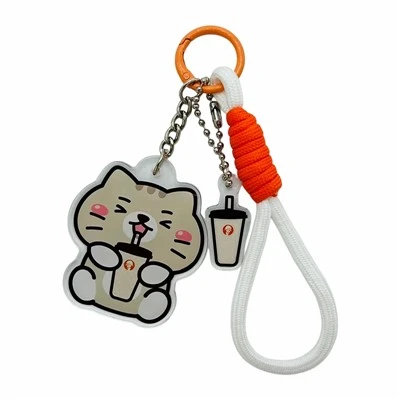
Over the years, we’ve found that customers don’t just want a keychain—they want a small, fun interaction. A thermal-sensitive keychain is a tiny, wearable surprise: when you pull your keys out of your pocket, you don’t expect them to change color, so it’s a little moment of joy every time. That’s why we love making them. If you have a design in mind, or you’re curious about how thermal-sensitive keychains could work for your brand, reach out to our team to discuss your project details, get a custom quote, and see free test samples of our thermochromic materials.
Laser-cut Keychains Reference
- Lewis, D. K. (2020). Thermochromic pigments and their applications in consumer products. Journal of Printing Science and Technology, 86(3), 112-121.
- Industrial Plastic Association. (2022). Laser processing of specialty acrylic materials: Safety, settings, and quality control. Technical Bulletin 412.
- Vinyl Industry Association. (2021). Adhesive performance of thermochromic vinyl for decorative applications. Annual Technical Report.
Wenzhou Qumange Craft Co., Ltd.
With abundant experience, we are one of the most professional laser-cut keychains manufacturers in China. Welcome to wholesale bulk customized laser-cut keychains at competitive price from our factory. If you have any enquiry about pricelist and free sample, please feel free to email us.
Address: Room 802, Building A1, Yuehu Light Industrial Park, Taishun County, Wenzhou City, Zhejiang Province, China
E-mail: 13806616181@139.com
WebSite: https://www.qmgcraft.com/
