As a blow molding mold supplier who’s spent the last 12 years standing beside production floor teams in 17 different countries, I’ve learned a hard truth: a mold that looks “perfect” on a design sheet isn’t the same as a mold that performs. Too many of my first clients tried to judge performance only by how smooth the mold’s steel finish looked, or how closely the 3D model matched the final part—and that’s exactly how they ended up with molds that produced 20% more defective parts, ran 3 hours less per shift, and cost twice as much to maintain as they should have. Blow Molding Mold

Measuring blow molding mold performance isn’t rocket science, but it requires a mix of hands-on floor data, material science basics, and a supplier’s deep understanding of how molds interact with your production line. Let’s break down the metrics I use with every client, how to measure them correctly, and what they actually mean for your bottom line.
First, let’s start with the most misunderstood metric: cycle time efficiency. A lot of production managers will tell you their mold’s cycle time is “45 seconds”—but that number is meaningless unless you’re measuring it across a full 8-hour production run, not just a test run on the toolroom floor. Here’s why: test runs are done with perfect parison programming, optimal air pressure, and no interruptions, but real production has mold cooling variations, parison fluctuations from extruder wear, and even small power blips that add time. For a 2-liter HDPE jug mold, a 45-second test cycle might stretch to 52 seconds on the floor, costing you 78 extra minutes of idle time per day. To get an accurate number, log cycle time every 10 minutes for a full shift, then calculate the average plus the standard deviation—any deviation over 10% is a red flag, because it means the mold isn’t holding consistent tolerances, and you’ll waste more material adjusting it mid-run.
Next, part rejection rate. This is where a lot of new clients get it wrong: they count all defective parts and divide by total parts, but not all rejections are the mold’s fault. Defects can come from resin inconsistencies, extruder temperature drift, or operator error. So to measure mold-specific rejection rate, you need to split defects into three categories: mold-related, machine-related, and material-related. Mold-related defects are the ones that show up in every run on that tool: thin sidewalls on the jug’s handle, flash along the mold’s parting line, or inconsistent neck diameter that won’t fit your cap. For example, last year a food packaging client brought me a mold that was spitting out 8% defective jugs, but when we split the rejections, 7% were mold-related—thin walls caused by uneven cooling channels inside the mold. We redesigned the cooling layout, and their rejection rate dropped to 1.2% overnight. A good rule of thumb: if mold-related rejections are over 1%, your mold’s performance is below average. If it’s under 0.5%, you’ve got a high-performing tool.
Then there’s mold uptime and maintenance frequency. This metric is all about how much time your mold is actually running, not sitting idle being repaired. I usually track uptime as (total run time) divided by (total shift time minus scheduled downtime for material changes) multiplied by 100. For most blow molding operations, a good mold should have 85% or higher uptime over a 30-day period. What kills uptime? Poor venting, for one. If a mold’s vents are clogged with resin dust or carbon buildup, you’ll get trapped air in the parison, which causes part bubbles, and you’ll have to stop every 200 cycles to clean the mold. I’ve seen molds with bad venting need cleaning every 1,000 cycles, while a well-designed mold only needs deep cleaning every 10,000 cycles. Also, track how many major maintenance repairs you do per month—things like replacing core pins, fixing mold alignment, or repairing cooling lines. A high-performing mold should only need one major repair every 6 months, tops. If you’re doing them more often, the mold wasn’t built with the right steel or design for your application.
Speaking of material yield, that’s another critical performance metric. Material cost is 60-70% of your total production cost for blow molded parts, so every percentage point of yield matters. Yield is (good parts produced) divided by (total resin used) multiplied by 100. A high-performance blow mold should have a yield of 92% or higher. Why would a mold lower yield? Uneven wall thickness. If one side of a part is too thin, you have to trim off excess resin, or the part will be too weak to pass safety tests. Last quarter, a automotive parts client came to me with a mold for HDPE fuel line components—their yield was only 87%, costing them $12,000 a month in wasted resin. We adjusted the parison programming slots in the mold and added additional support cores to balance wall thickness, and their yield jumped to 94%, a 7% increase that paid for the new mold in 2 months.
Now, let’s talk about durability, which is a long-term performance metric that many businesses skip. A good blow molding mold should last at least 1,000,000 cycles with minimal wear, depending on the resin and part. For example, a mold for rigid HDPE packaging will last longer than one for soft PVC, which is more abrasive. To measure durability, track the number of cycles between major part dimension changes. If your part’s neck diameter starts to drift after 300,000 cycles, that means the mold’s steel is too soft, or the alignment pins are wearing out. I once worked with a cosmetic packaging company that used a mold made from generic tool steel instead of P20 grade, which is standard for blow molding. Their mold only lasted 250,000 cycles before they had to replace it, costing them $15,000 in extra mold fees. When we switched them to P20 with induction-hardened core pins, their mold lasted 1.2 million cycles, no issues.
Wait, I know what you’re thinking—this sounds like a lot of numbers, and you’re probably asking, “How do I get all this data without spending hours tracking every cycle?” The good news is, as a mold supplier, we can help you set up simple tracking systems that don’t require expensive software. We recommend starting with a basic Excel sheet: log cycle time every hour, count mold-related defects, and mark when the mold is taken down for maintenance. For uptime, your production line’s HMI (human-machine interface) usually already logs run time and downtime, so you just need to separate mold-related downtime from other issues.
But here’s a key point I’ve learned from years in this industry: don’t measure these metrics in isolation. A mold might have a great cycle time, but if its rejection rate is high, it’s not performing well. Or it might have low maintenance, but its material yield is 5% below average, so you’re wasting more money on resin than you’re saving on repairs. The sweet spot for a top-performing blow molding mold is: cycle time variance under 5%, mold-related rejection rate under 0.5%, uptime over 88%, yield over 93%, and durability over 1 million cycles for standard HDPE parts.
Of course, there are exceptions. If you’re blow molding a large industrial part, like a 55-gallon plastic drum, your metrics will be a bit different. Cycle time will be longer, maybe 2-3 minutes, and yield might be slightly lower because of the complex shape. But the core idea remains: the mold’s performance is tied to how it works with your specific resin, part design, and production line, not just the initial price tag.
I’ve seen too many clients choose the cheapest mold, only to regret it 6 months later when they’re dealing with constant defects, downtime, and replacement costs. That’s why as a supplier, I don’t just sell you a mold—I help you measure its performance from the first test run, so we can adjust the design or materials before it goes into full production. For example, last year a client wanted a mold for 1-liter plastic water bottles, and they went with a competitor’s mold that cost $2,000 less. Their initial test run had a cycle time of 50 seconds, but after a week, the cycle time stretched to 58 seconds, and their rejection rate hit 3%. When they reached out to us, we redesigned the cooling channels and used a higher grade of steel, which brought their cycle time back to 47 seconds, rejection rate down to 0.8%, and uptime up to 90%. The new mold cost $3,500, but they saved $8,000 in the first 3 months from reduced material waste and downtime.
At the end of the day, measuring blow molding mold performance is about tying every metric back to your actual production costs. A mold that looks good on paper might not be the right fit for your operation, but when you track cycle time, rejection rates, uptime, yield, and durability, you can spot issues early and make sure your mold is delivering the value you need.
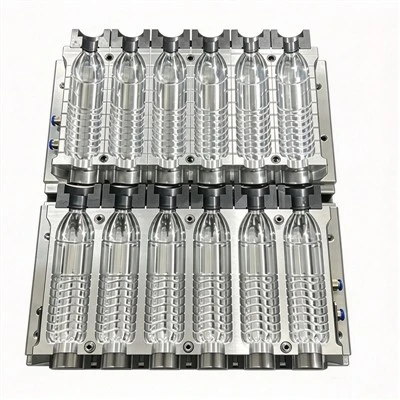
If you’re currently evaluating blow molding molds for your operations, or if you’re looking to improve the performance of an existing mold, reach out to us to discuss your specific needs. We can walk you through how to implement these measurement metrics, share real-world data from similar operations, and find a mold that aligns with your production goals.
Mold Accessories References:
- Rosato, D. V., & Rosato, M. G. (2004). Blow Molding Handbook. Hanser Gardner Publications.
- Popescu, C., & Dima, I. (2019). “Performance Metrics for Injection and Blow Molding Molds.” Journal of Manufacturing Processes, Vol. 41, pp. 287-294.
- The Society of Plastics Engineers (2021). Blow Molding Design Guide, 3rd Edition. SPE International.
- American Society of Mechanical Engineers (2020). Standard Practice for Evaluating Mold Performance in Plastics Processing. ASME B106.1M-2020.
Taizhou Leizhen Mold Co., Ltd.
Taizhou Leizhen Mold Co., Ltd. is one of the most professional blow molding mold manufacturers and suppliers in China, also supports customized service with low price. Please feel free to buy CE approved blow molding mold made in China here from our factory. Contact us for pricelist.
Address: No.8828, Changtang Industrial Zone, Beicheng Street, Huangyan District, Taizhou City, Zhejiang Province
E-mail: ningleizhen@gmail.com
WebSite: https://www.leizhenmold.com/
